
High-Quality Surveys (HQS) under the MDR – A Concise Overview
Picture: AI generated
By Dr. David Ruseckas, Dr. Monika Hann and Barbara Othmar
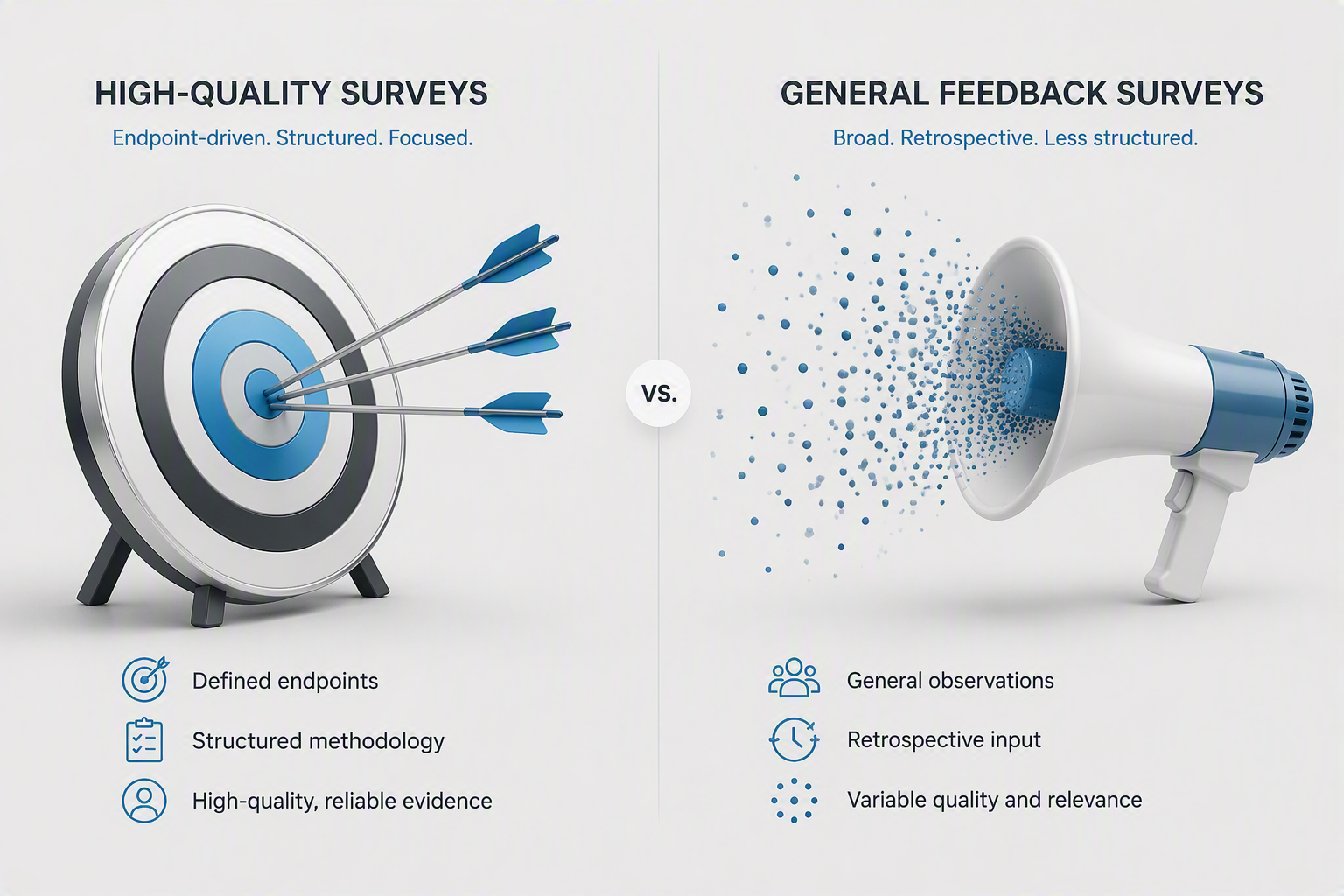
High-Quality Surveys (HQS) are an elegant type of study that is increasingly used by medical device manufacturers to support the Post-Market Clinical Follow-Up (PMCF) activities required under the European regulatory framework. Although the term “High-Quality Survey” is not explicitly defined in the legislation, it is commonly understood to correspond to Level 4 clinical evidence as described in Appendix III of MDCG 2020-6. (1)
MDCG 2020-6 describes Level 4 clinical evidence as: “Outcomes from studies with potential methodological flaws, but where data can still be quantified and acceptability justified.” (1)
In practice, this usually refers to structured surveys that may lack features such as monitoring or formal data cleaning. As a result, they are more cost-effective compared to observational studies, while still generating quantifiable and scientifically justifiable outcomes.
As noted in the Journal of Medical Device Regulation (2023, 20(4), 31–44), there are no formally established regulatory criteria that define what qualifies as a “High-Quality Survey.” (2) The term is therefore derived from an interpretation of the MDCG evidence hierarchy rather than from explicit legal terminology.
Regulatory Context under the MDR
Under the Medical Device Regulation (MDR), manufacturers are legally required to maintain continuous clinical evaluation throughout the entire lifecycle of a device through PMCF activities. (3) Manufacturers must document the results of these activities in different documents depending on the device classification:
- Class I devices: In a Post-Market Surveillance report (PMS Report) summarizing the results and conclusions of the post-market surveillance data collected. (3)
- Class IIa, IIb, and III devices: In a Periodic Safety Update Report (PSUR), with the update frequency depending on the device class. (4)
Less systematic investigations, such as user feedback, may also be used by manufacturers to collect information on safety, performance, and effectiveness, which is then included into the PSUR and PMS Report. (5) Additional clarification on post-market surveillance obligations is provided in Medical Device Coordination Group document MDCG 2021-24. (6)
For both report types, customer surveys such as High-Quality Surveys can serve as tools for collecting PMCF data. They are therefore often described in the Post-Market Surveillance Plan (PMS Plan) as one of the methods for planned data collection. (5)
Level 4 vs. Level 8 Surveys
According to MDCG 2020-6, PMCF data sources are categorized by their level of clinical evidence. (1) Unlike evidence based purely on statistical outputs, clinical evidence also considers study quality (for example, external monitoring and data cleaning), quantity (sample size), completeness of data, and statistical validity.
For legacy Class III and implantable devices that are not considered well-established technologies, the MDCG suggests that manufacturers should aim to obtain at least Level 4 clinical evidence.
Within PMCF activities, two common survey types can therefore be distinguished:
Level 4 (HQS) surveys are typically:
|
Level 8 surveys, by contrast, are usually:
|
HQS therefore represent a mid-level, structured, and scientifically planned PMCF activity that can provide an acceptable level of clinical evidence when a full clinical investigation is not required.
Conclusion
Although “High-Quality Survey” is not a legally defined term under the MDR, it has become an established concept for generating data that supports regulatory requirements. Positioned at Level 4 of the MDCG evidence hierarchy, HQS provide quantifiable, prospectively collected PMCF data while remaining distinct from formal clinical investigations.
When properly designed – with clear objectives, an adequate sample size, structured questionnaires, and statistical planning – HQS are an effective, appropriate, and relatively low-cost tool for supporting lifecycle clinical evaluation under the MDR.
Sources
(1) Medical Device Coordination Group. MDCG 2020-6: Guidance on sufficient clinical evidence for legacy devices under the MDR, Appendix III.
(2) Journal of Medical Device Regulation. “High Level (Level 4) PMCF Surveys – What Are They?” 2023; 20(4): 31–44.
(3) Medical Device Regulation (EU) 2017/745, Articles 2(45) and 86.
(4) MDCG 2022-21 GUIDANCE ON PERIODIC SAFETY UPDATE REPORT (PSUR) ACCORDING TO REGULATION (EU) 2017/745 (MDR) December 2022
(5) MDCG 2025-10 Guidance on post-market surveillance of medical devices and in vitro diagnostic medical devices December 2025
(6) MDCG 2021-24. Guidance on Post-Market Surveillance under Regulation (EU) 2017/745.