
IMPs vs. AxMPs: What’s the Difference and Why Does It Matter?
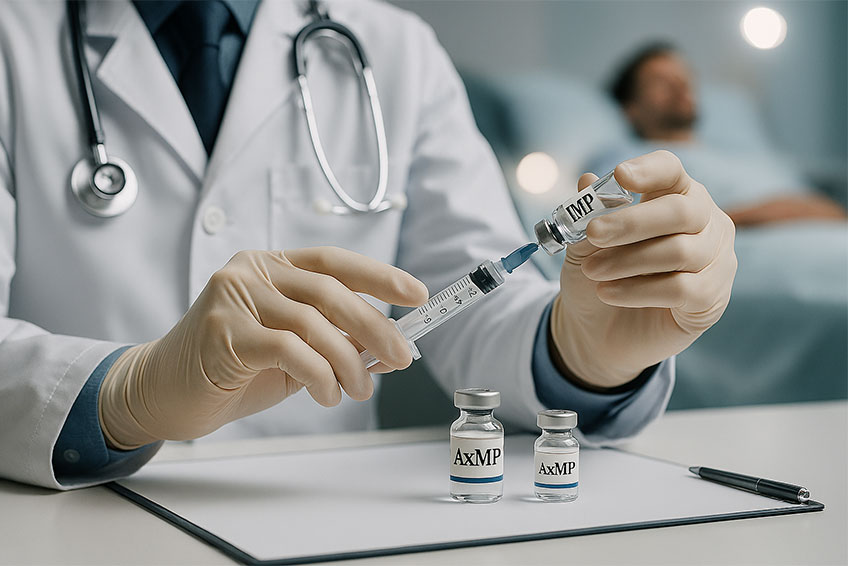
Picture: AI generated
Dr. David Ruseckas and Barbara Othmar
In clinical trials, distinguishing between Investigational Medicinal Products (IMPs) and Auxiliary Medicinal Products (AxMPs or AMPs) is essential for regulatory compliance, robust trial design, and patient safety.
Recently, the Clinical Trials Coordination and Advisory Group (CTAG) issued updated recommendations on the use of AxMPs in clinical trials, providing further clarification and guidance (1).
Definitions
- Investigational Medicinal Product (IMP): A medicinal product which is being tested or used as a reference, including as a placebo, in a clinical trial (2).
- Auxiliary Medicinal Product (AxMP/AMP): A medicinal product used for the needs of a clinical trial as described in the protocol, but not as an IMP—for example as background treatment, rescue medication, or challenge agent (1) (2).
Examples for AxMP
- Background treatment: Standard-of-care treatment that participants receive alongside the IMP. The recent CTAG guidelines clarify that such treatments are typically considered AxMP unless the trial specifically aims to compare two standard treatments.
Example: A new anti-HIV drug tested in patients receiving standard antiretroviral treatment. The new drug is the IMP; the standard therapy is an AxMPs if used only as background treatment.
- Rescue medication: Used when the IMP does not adequately control the disease.
Example: In a clinical trial of a new painkiller, the investigational analgesic is the IMP. Opioids given as backup are AxMPs.
- Trial-Related Diagnostics: Drugs used solely for diagnostic purposes are generally AxMPs unless they serve as reference medication.
- Challenge agents: Medicinal product administered to elicit a physiological response required before assessing the IMP’s effect.
Example: In an allergy drug trial, allergens used in diagnostic prick tests are AxMPs.
Why the Distinction Matters
1. Regulatory Requirements
- IMPs require registration in CTIS (clinical trial information system), an IMP dossier (full or simplified), GMP compliance documentation, and specific labeling.
- AxMPs, if authorized, have less stringent requirements unless used in non-standard ways.
2. Pharmacovigilance Obligations
- IMPs are fully subject to safety reporting, including expedited reporting of Suspected Unexpected Serious Adverse Reactions (SUSARs)
- Authorised AxMPs are not subject to the same reporting requirements, unless suspected of causing or contributing to an adverse reaction.
- Correct classification avoids unnecessary safety reporting workload while ensuring participant safety.
3. Operational Efficiency & Risk Mitigation
Misclassification can lead to regulatory non-compliance, approval delays, and unanticipated costs, especially in multi-country trials.
4. Financial Responsibility
- Sponsors bear all IMP-related costs (manufacturing, labelling, destruction), which can represent 3–10% of total trial costs.
- AxMP costs may fall to hospitals or health systems unless otherwise agreed.
Conclusion
Clear differentiation between IMPs and AxMPs is fundamental for regulatory compliance, patient safety, and efficient trial execution. As clinical trials become increasingly complex and global, accurate classification is more important than ever.
References
(1) Clinical Trials Coordination and Advisory Group. Recommendations on the use of Auxiliary Medicinal Products in Clinical Trials written and endorsed by the Clinical Trials Coordination and Advisory Group (CTAG). Available from: https://health.ec.europa.eu/document/download/1bf35e45-134c-4f2e-9c68-0e8537eef867_en?filename=mp_axmp_rec_en.pdf. Accessed 08 December, 2025.
(2) European Parliament and the Council. REGULATION (EU) No 536/2014 OF THE EUROPEAN PARLIAMENT AND OF THE COUNCIL: REGULATION (EU) No 536/2014 OF THE EUROPEAN PARLIAMENT AND OF THE COUNCIL of 16 April 2014 on clinical trials on medicinal products for human use, and repealing Directive 2001/20/EC. Available from: https://eur-lex.europa.eu/eli/reg/2014/536/2022-12-05. Accessed 09 December, 2025.